Financing
You bought the EV - now make it (nearly) free to drive

Golden Bear Staff
Congratulations - you made the switch to an EV. You're done paying $70 (hello... $100??) to fill up a gas tank. But here's what a lot of new EV owners discover quickly: in California, electricity isn't exactly cheap either. With PG&E, SCE, and SDG&E rates ranging from 31¢ to 47¢ per kWh, plugging into the grid at peak hours can cost more than you bargained for.
The question isn't whether solar + battery storage makes sense for EV owners. The question is how to calculate it - and how to put real numbers to your specific situation. This guide walks you through the ROI framework, using 2026 California data, so you can make a confident decision.
The EV Changes Your Energy Math Completely
A conventional home in California uses roughly 7,000–10,000 kWh per year. Add a Chevy Bolt - one of the most efficient EVs on the road (and this author's car!) - and you're adding approximately 2,400–3,500 kWh annually, depending on how much you drive. That's a 25–50% jump in your household electricity consumption.
That's not bad news. It's actually a tremendous opportunity. Here's why:
|
Charging Scenario |
Cost per kWh |
Annual Cost (12k mi) |
|
Grid peak (SCE) |
~$0.35–0.47/kWh |
~$840–$1,130/yr |
|
Grid off-peak (TOU) |
~$0.14–0.18/kWh |
~$340–$435/yr |
|
Solar self-consumption |
~$0.02–0.04/kWh* |
~$50–$100/yr |
|
Gas equivalent (CA avg.) |
$4.50–$6.15/gallon |
~$1,350–$1,840/yr |
* Marginal cost post-payback for solar self-consumption. Assumes Chevy Bolt EV at ~3.45 miles/kWh, 12,000 mi/yr.
The table above tells a clear story. Solar-powered EV charging costs roughly 13–90x less per kWh than what Californians pay at peak grid rates or at a public fast charger. Even compared to discounted off-peak rates, solar self-consumption is dramatically cheaper - and it's available 25+ years after payback.
Why Solar Alone Isn't Enough Anymore (Enter: The Battery)
Under California's current Net Energy Metering rules (NEM 3.0), the dynamics shifted significantly from the old NEM 2.0 program. Here's the critical difference:
|
NEM 2.0 (pre-April 2023): Excess solar exported to the grid earned near-retail credits (~$0.30–0.35/kWh) NEM 3.0 (today): Exported solar earns only "avoided cost" rates of ~$0.05–0.08/kWh - a ~75% reduction |
Translation: giving solar energy away to the grid is no longer financially smart. The winning strategy under NEM 3.0 is self-consumption - store what your panels produce during the day, then use it during the expensive 4–9 PM peak window when rates spike highest.
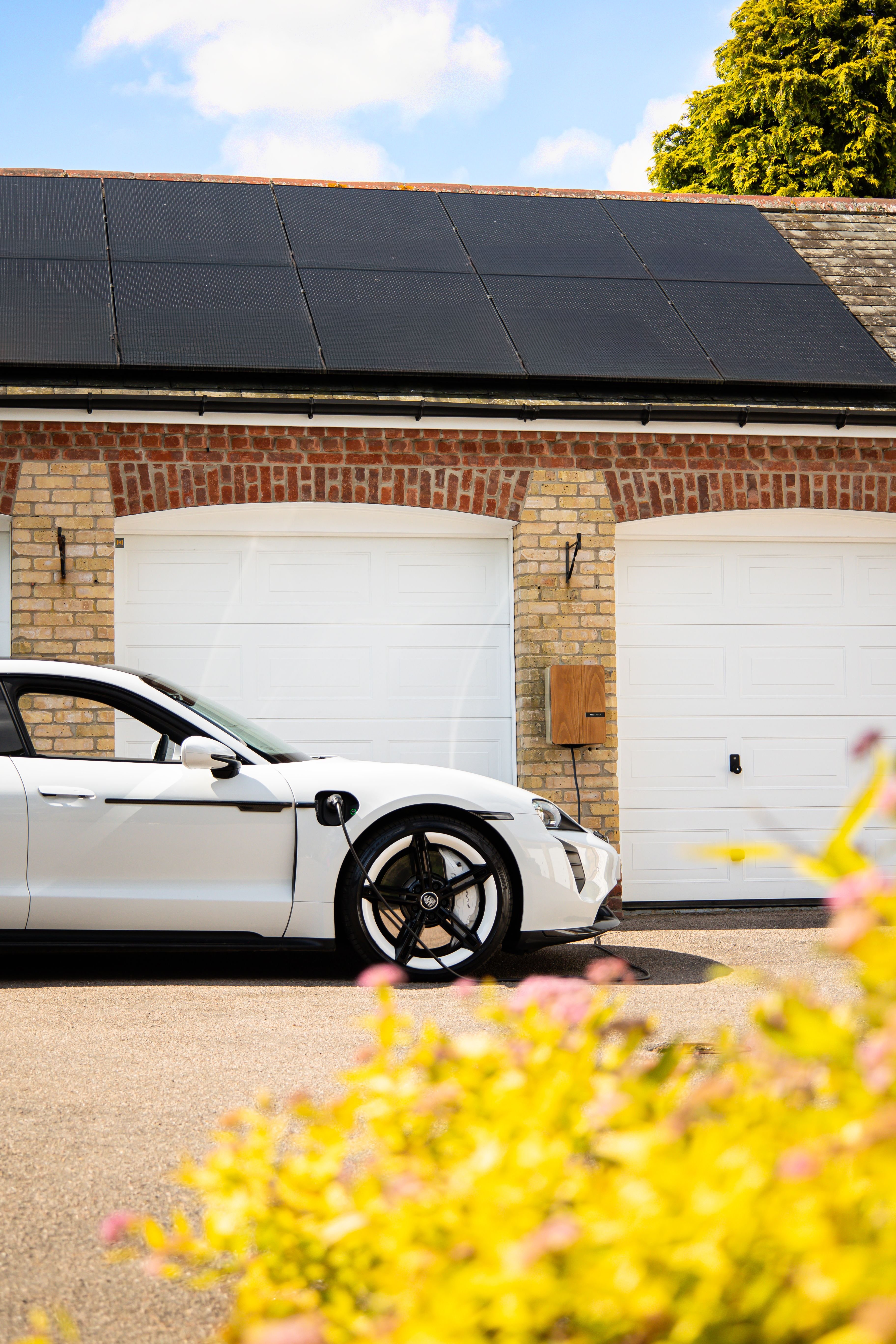
This is exactly what a home battery does. And for EV owners, it creates a beautifully efficient loop: your solar panels charge your battery during the day, and your battery charges your EV at night - at a cost close to zero.
|
CPUC data: Solar-plus-storage systems save at least $136/month vs. solar-only configurations that save ~$100/month — with significantly shorter payback periods under NEM 3.0. |
How to Calculate Your ROI: A Real Framework
ROI for solar + battery is straightforward once you understand the three savings streams that work in parallel. Here's how to think about it:
Step 1: Baseline Your Current Energy Costs
|
Monthly electric bill |
Your starting point — what you pay today |
|
Annual EV fuel cost |
Miles ÷ 3.45 (Bolt efficiency) × your kWh rate |
|
Annual gas you no longer pay |
Already saved by going EV — this is a 'free' win |
|
Utility rate escalation |
CA rates have risen ~8–13% annually in recent years |
Step 2: Size Your System for Self-Consumption
An EV changes your ideal solar system size. Most California homes without an EV need a 6–8 kW system. Add a Bolt (or similar), and you'll likely want 9–12 kW to cover both home and car needs - especially under NEM 3.0 where oversizing and exporting is penalized.
Rule of thumb: Size for ~80–100% of your total electricity use (home + EV charging), prioritizing daytime self-consumption over grid export.
Step 3: Apply Current Costs and Incentives
|
Cost/Incentive Item |
Before Incentives |
After Incentives |
|
Solar system (avg. CA, ~10 kW) |
~$25,000–$30,000 |
See note below* |
|
Battery storage (e.g., Powerwall) |
~$9,000–$18,000 |
~$6,000–$12,000 |
|
CA SGIP battery rebate |
Up to $1,000+ |
Applied to battery cost |
|
Property tax exemption |
System value excluded |
Saves $200–$400/yr |
|
Level 2 EV charger add-on |
~$1,000–$2,000 |
30% federal credit (30C)† |
* The 30% federal residential solar tax credit (25D) expired December 31, 2025, for direct cash/loan purchases. A prepaid lease structure can still access equivalent savings through the commercial 48E credit. Ask your installer about current financing structures.
† The 30C EV charger tax credit is available through June 30, 2026. Act now to capture this incentive.
Step 4: Calculate Payback and Lifetime ROI
Payback Period Formula: Total Net System Cost ÷ Annual Savings = Years to Break Even
Annual savings for an EV household includes three stacked benefits:
- Electricity bill reduction: Typical solar + storage saves $1,600–$2,400/year on home energy
- EV charging savings: Moving from ~$0.35/kWh grid peak to ~$0.02/kWh solar = $700–$1,100/year in avoided charging costs
- Utility rate hedge: Each 10% rate increase means ~$160–$340 more in annual savings
|
Sample Scenario (Bay Area EV owner, PG&E territory): Net system cost: ~$22,000 (solar + battery, after incentives) Annual savings (home + EV): ~$2,800/year Payback period: ~7.9 years 25-year total savings: ~$75,000–$95,000 (with rate escalation) Total ROI: ~240% over system lifetime |
The Wildfire + PSPS Bonus: ROI Beyond the Spreadsheet
Any honest ROI analysis for California homeowners in 2026 has to include a factor that doesn't fit neatly into a spreadsheet: grid vulnerability.
PG&E and SCE have dramatically expanded Public Safety Power Shutoffs (PSPS) in recent years - cutting power for days at a time across high-fire-risk areas. For EV owners, this creates a painful irony: your car could be stranded with a dead battery right when you most need to evacuate. (And... often a garage door that won't open!)
A battery backup system solves this. And Golden Bear Solar's Wildfire Defense System takes it a step further - pairing solar and battery backup with roof-mounted ember suppression sprinklers that address the #1 cause of home loss in wildfires: flying embers that ignite roofs during a fire event.
|
The Wildfire Defense System includes: • Roof-mounted ember suppression sprinklers — stops the #1 cause of home ignition • Solar panels — power your home and charge your EV for free • Battery backup — keep your lights on and your EV charged through any PSPS event |
Add in the insurance angle: dozens of major insurers have exited California or raised premiums dramatically. Documented wildfire mitigation systems - like ember suppression - may support insurance reinstatement or premium reduction conversations. That's a financial benefit that's hard to ignore.
Your Quick-Reference ROI Checklist
Before you call a solar installer, here's what to gather so they can give you an accurate quote and payback estimate:
- Last 12 months of utility bills (average kWh/month)
- Your EV's annual mileage and whether you charge primarily at home
- Your utility and current rate plan (TOU vs. tiered)
- Roof age, orientation, and shading conditions
- Whether you're in a high fire-risk or PSPS-prone area
- Your homeownership tenure (longer = better ROI case)
- Whether you have or plan to add any other electric loads: heat pump, EV #2, pool pump
Armed with this, a good solar + storage installer can model your specific payback period and 25-year savings with real accuracy — not ballpark guesses.
|
Ready to Run Your Numbers? Golden Bear Solar has been installing solar and battery systems across the Bay Area and Los Angeles since 2009. We'll assess your home, size your system for your EV, and show you a real, no-fluff payback analysis. Call 833-GBSolar | contact@goldenbearsolar.com | goldenbearsolar.com Family-owned since 2009 • Bay Area & Los Angeles • CA License #940091 |